
Critique Magid’s “Ending the Pursuit of Happiness”
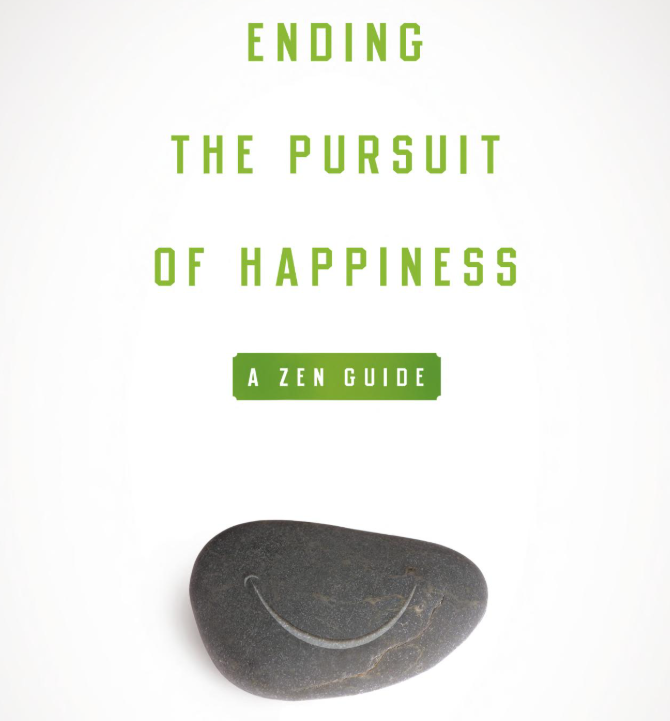
Barry Magid’s Ending the Pursuit of Happiness attempts a noble task: to strip spiritual practice of its hidden self-improvement agendas and expose how our quest to “feel better” becomes another form of suffering. As a psychoanalyst and Zen teacher, Magid argues that our efforts to become calm, enlightened, or fixed only deepen our sense of deficiency. In his words, meditation should not be used as a “cure” for being human. Instead, he proposes radical acceptance — just sitting with what is.
But while compassionate in tone and psychologically astute, the book ultimately falls into a subtle but serious deviation from the Buddha’s teachings: it confuses non-striving with non-engagement, and acceptance with abandoning discernment. More critically, it assumes an interpretive authority over the Dhamma without proper grounding in the core map laid out by the Buddha.

1. The Buddha Did Not Teach “Let Everything Be”
Magid’s central thrust — that striving is the enemy — overlooks how the Buddha framed practice. The Four Right Exertions instruct us to abandon unwholesome states, prevent their arising, cultivate wholesome ones, and maintain them. This is not perfectionism. It is training. While Zen can rightly highlight the pitfalls of craving for attainment, Magid goes too far in suggesting that addressing hindrances — such as sloth, restlessness, or craving — is itself an expression of delusion.
The Buddha disagrees. In Majjhima Nikāya 2 (Sabbāsava Sutta), he describes various defilements that are to be removed by seeing clearly, by restraint, by reflection, by enduring, by avoiding, by removing, and by developing. None of this implies passive witnessing.

2. For example: Sleepiness Isn’t “Just Another Thing” — It’s a Hindrance
Magid suggests we should “just be with” things like drowsiness or agitation, rather than “fix” them. But in the Bodhipakkhiyādhammā — the 37 factors of awakening — energy (viriya) and investigation (dhammavicaya) are critical to progress. The Buddha urged practitioners to actively respond to drowsiness by changing posture, contemplating light, or reflecting on death. This isn’t “striving to be better,” but skillful means to stay on the path.
Ignoring hindrances may feel wise, as it seems to accentuate the subtle root of suffering: craving something. Tanha, which is the running-away thirst, from Chanda or the natural craving, which leaves no residue. If you are hungry, then you eat. And if you are satisfied, then you stop leaving no residue. Magid confuses striving towards the other shore thirstily, employing the tools of the Dharma, as unskillful striving for some idealized state. The latter (aiming towards the ideal) needs to be seen as unskillful, while the former (aiming to navigate reality well) should be embraced as a skillful liberating practice until striving ceases, because the practice has been embodied.

3. We Must Know the Dharma Before We Claim to Represent It
Magid received Dharma transmission from Charlotte Joko Beck, who herself downplayed traditional structures of awakening, transmission, and even the authority of the suttas. But the Buddha warned of exactly this tendency in Majjhima Nikāya 38, when a monk named Sati misunderstood the nature of consciousness. The Buddha publicly corrected him, saying his distorted view misrepresented the Dhamma and led others astray.
Similarly, if one teaches acceptance without discernment, or presence without the cultivation of path factors, they are — knowingly or not — misrepresenting the Noble Eightfold Path. To teach rightly, one must first deeply understand what the Buddha actually taught.
4. Right View is the Foundation
The Buddha placed sammā-diṭṭhi — right view — at the beginning of the Noble Eightfold Path for a reason. Without it, meditation becomes quietism, mindfulness becomes mood regulation, and compassion becomes permissiveness. Magid’s approach has value, particularly for those wounded by harsh striving or perfectionism. But it must be realigned with right view, or else it devolves into well-meaning but incomplete dharma.
Conclusion
The Dhamma does not need to be modernized — it needs to be understood. While Barry Magid’s psychological insight can offer helpful bridges for some, no bridge is safe if it leads away from the path. The Buddha’s teaching is not merely about feeling at peace with what is, but about knowing what leads to suffering and what leads to its end — and then choosing accordingly.
Compassion without wisdom is sentiment. Wisdom without action is delayed. Let us return to the path — not just sincerely, but correctly.
The Enlightened Lifestyle: Advancing the Dharma.
The Enlightened Lifestyle honors the core teachings of the Buddha — particularly the cultivation of the Bodhipakkhiyādhammā, the Four Noble Truths, and the Eightfold Path — while making careful, critical distinctions where needed. For example, teachings in the Greater Discourse on the Causes (Mahānidāna Sutta) describe a metaphysical process in which consciousness departs at death and “enters” a womb, implying literal rebirth. This, along with cosmological realms, reflects ancient Indian worldviews and lacks empirical evidence. These are claims as speculative as those found in theistic traditions.
The Enlightened Lifestyle upholds the Buddha’s insights into suffering, causality, and liberation, while applying critical inquiry — asking, “What is really the case?” — alongside mind inquiry, which asks, “How should we respond well to it?” Other traditions modify, ignore or select from the bounty of the Buddha’s Dharma Teaching. EL is cautious to take what remains after the furnace of methodological naturalism, which is quite a bit, actually, while leaving the speculative rest. Modern practitioners must retain the heart of the Dhamma while exercising discernment, modifying only when necessary to preserve truth, not convenience, and never distorting the path to suit cultural comfort.
